
CASE STUDY: Turning a Finished Podcast Into a Searchable Content Library
What an Old Podcast Archive Taught Me About Human Clarity, AI, and Recommendation Systems

Can clearer episode titles and metadata help people rediscover a podcast’s back catalogue?
That question shaped an ongoing podcast growth experiment for the Expats, Geopats, Etc podcast, an interview show about identity, grounding, and life abroad. The podcast officially ended in 2022 after roughly 8 years and 92 episodes, which made it a strong testing ground because no new episodes were being released during the experiment.
Phase 1: August to October 2025
Phase 1 began with a broad archive optimization process focused on improving organization, metadata, transcripts, and supporting text to see how much these changes could impact discoverability and overall back catalogue clarity. After several months of promising results, Phase 2 narrowed the focus specifically to episode titles in order to better understand how much title clarity alone was influencing growth.
Phase 2: March to May 2026
During Phase 2, no new episodes were released and no promotional work was done. This created a more controlled environment for observing the impact of the episode title changes more clearly.
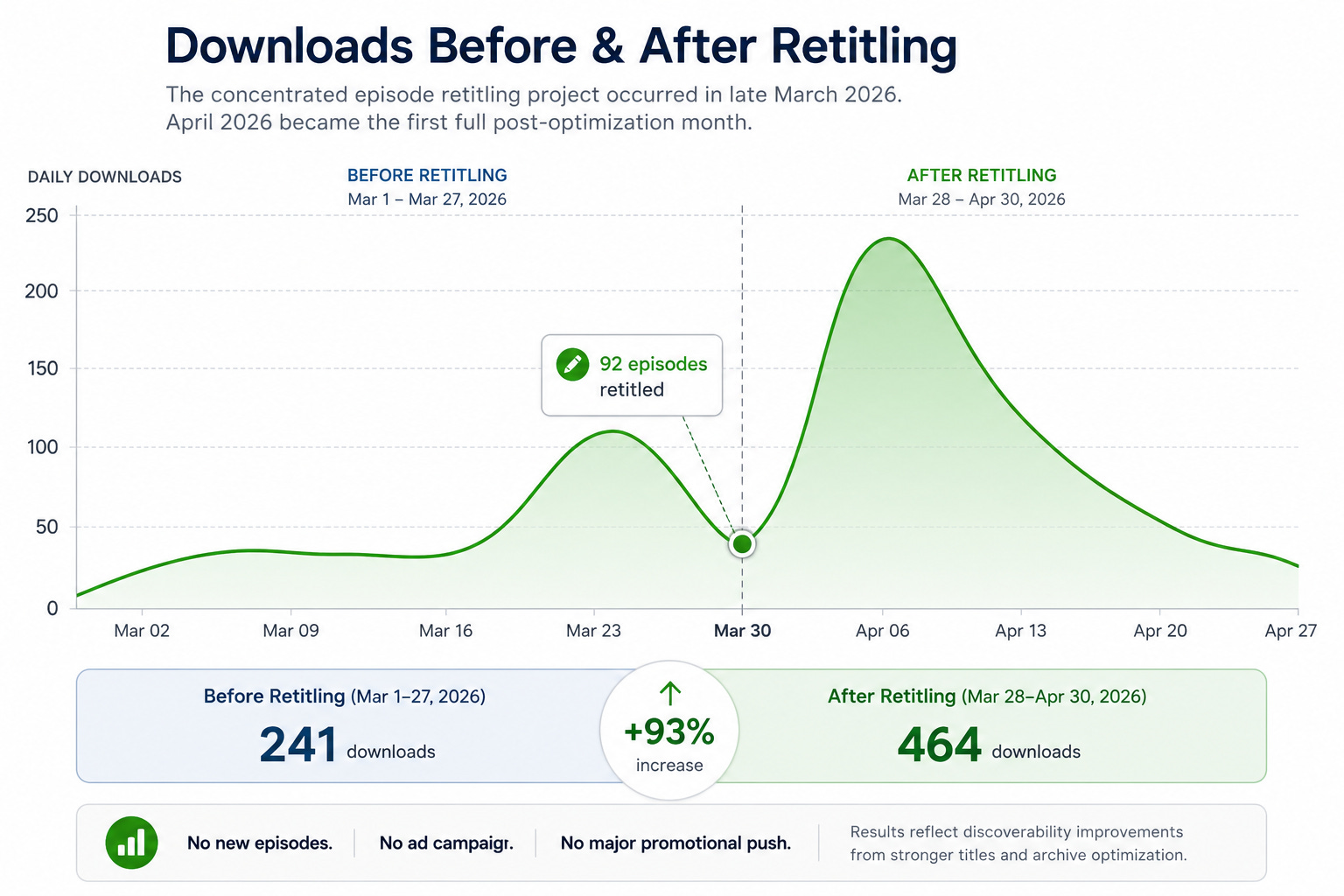
Phase 2 Key Outcome: Downloads increased from 241 → 464 first month post retitling
Download the case study:

Phase 1: Back Catalogue Refresh
From August to October 2025, before the specific episode retitling experiment began, earlier optimization work was completed.
Phase 1 optimization work included:
reorganizing episodes into thematic seasons
creating season trailers
refining show notes
improving transcripts
refining metadata structure
removing outdated references
improving archive consistency
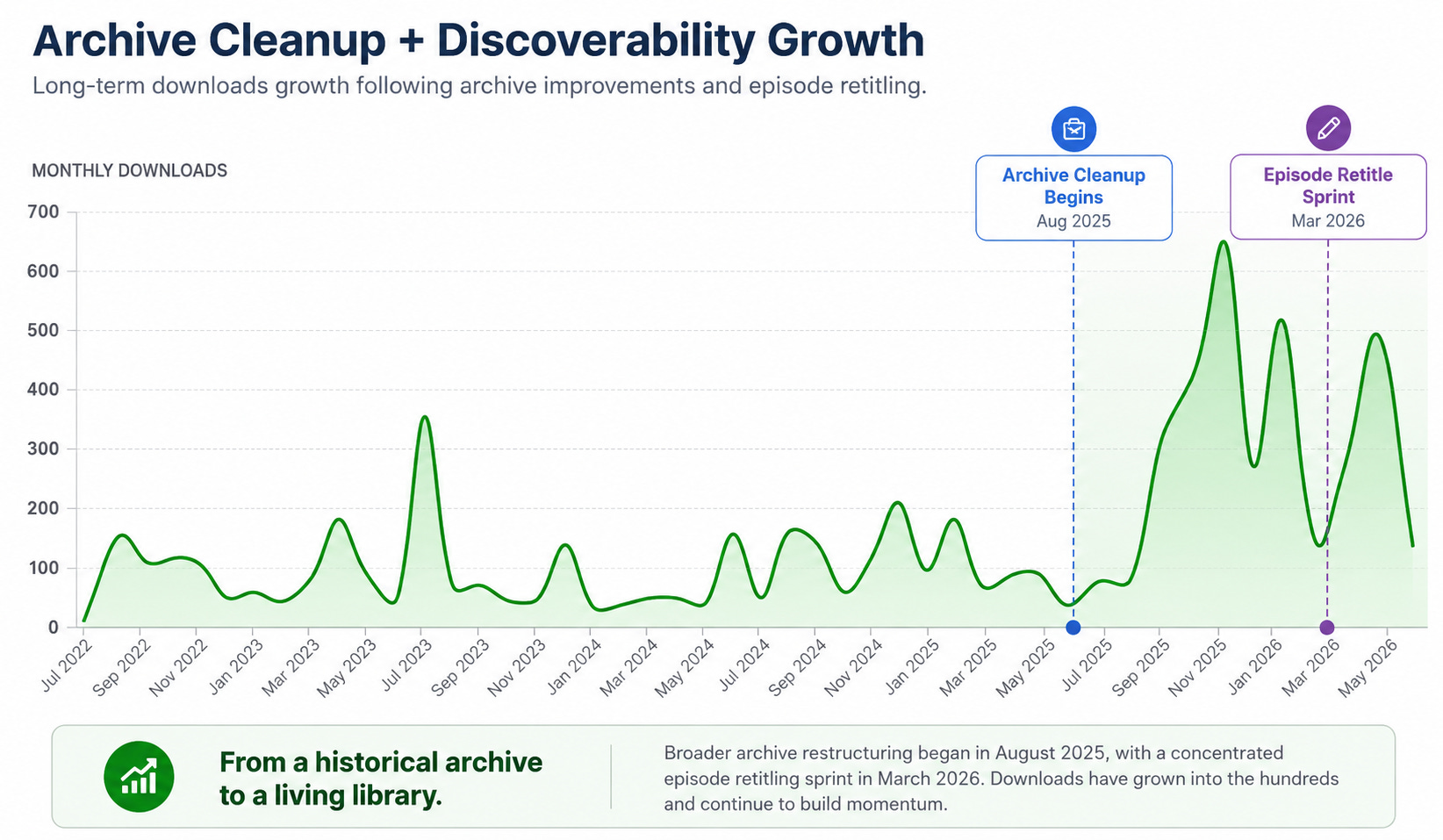
The growth in that time (shown below) is what inspired this episode title specific experiment. This first phase started the episode transformation from a historical collection of episodes into a more navigable and searchable content library.
Monthly downloads, which had often hovered around roughly 50 downloads per month, began moving into the hundreds during this phase.
Where the Original Podcast Titles Fell Short
The fast pace of maintaining a consistent publishing schedule often creates a long-term discoverability problem. Episode titles are frequently written quickly, with more focus on getting the episode published than clearly communicating its lasting value to both humans and recommendation systems.
Over time, perspective, nuance, emotional framing, and strong listener-facing phrasing can gradually get buried inside overly conversational or overly broad titles. As a result, valuable conversations may become harder for both humans and recommendation systems to quickly interpret.
Example 1: A moment from the episode instead of the overall promise
Before: “Pet culture shock in China?”
After: “Living Abroad in China: Culture, Dogs, and Expat Life in Shanghai”
Example 2: Overly broad podcast episode titles
Before: “First China culture shocks for an American expat”
After: “Expat Life in Shanghai: What Americans Get Wrong About Moving to China”
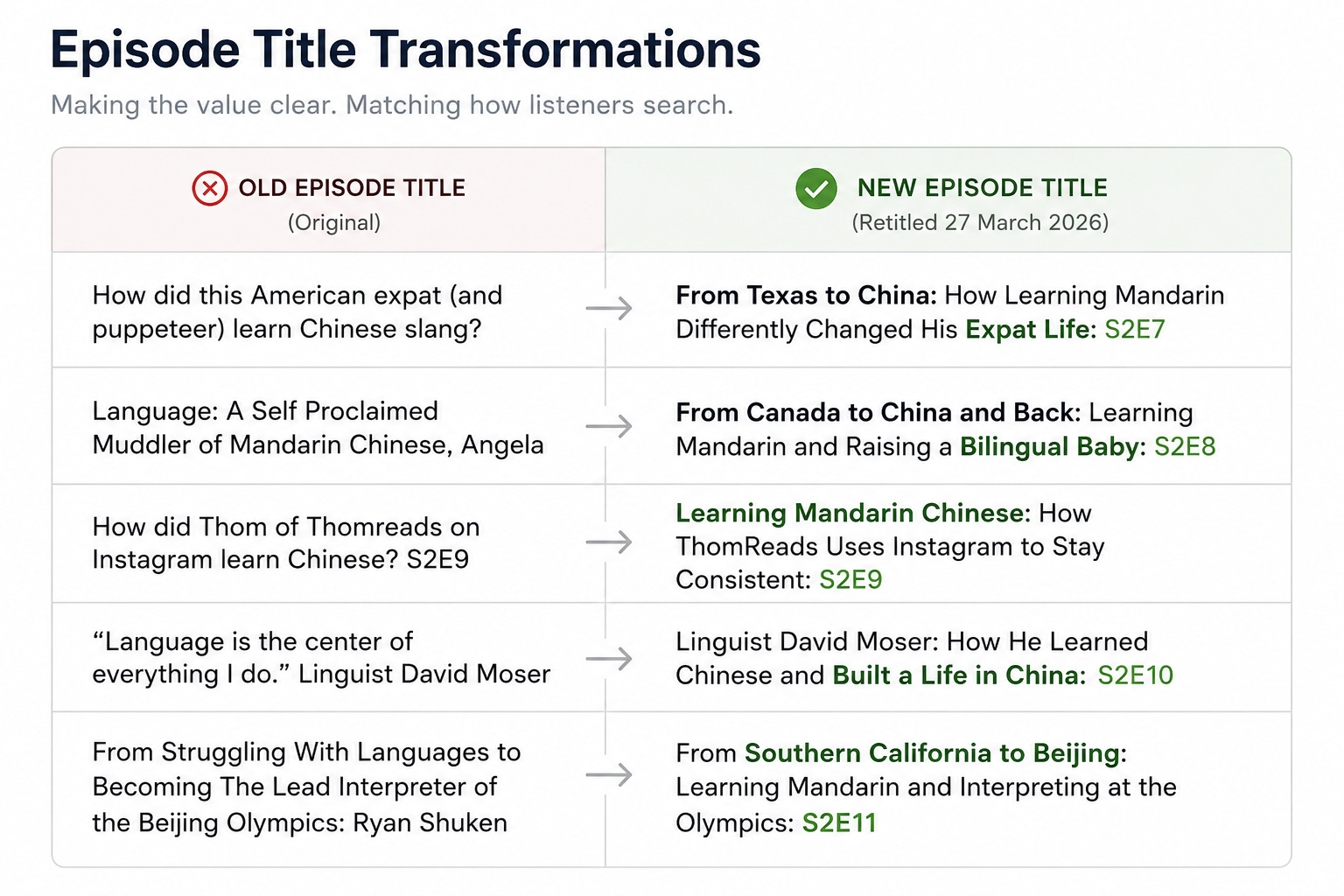
The newer titles aligned more closely with the language and context listeners might realistically use when searching for relocation-related content.
Likely listener search behavior, including phrases such as:
“expat life in Shanghai”
“moving abroad to China”
“culture shock in China”
“American expat in Shanghai”
The goal was not clickbait. It was clearer listener signaling.
Phase 2: The Podcast Episode Retitling Sprint
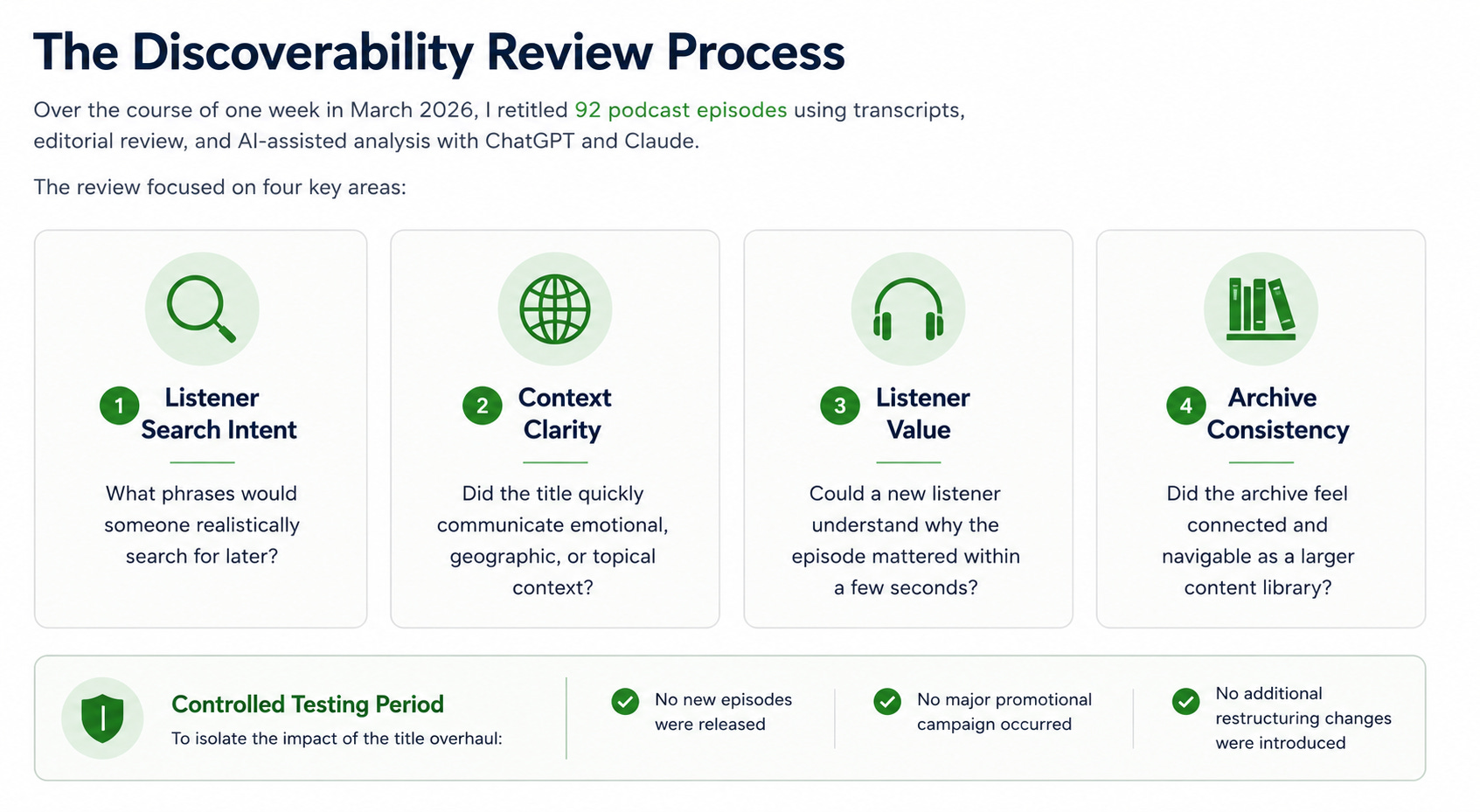
Over the course of one week in March 2026, I retitled 92 podcast episodes using transcripts, human editorial review, and AI-assisted analysis with ChatGPT and Claude.
This was not an automated process. Each episode title went through multiple rounds of refinement focused on improving listener clarity, emotional context, geographic specificity, and long-term search visibility while still preserving the tone and intent of the original conversation.
Importantly, during this concentrated title testing period:
no new episodes were released
no major promotional campaign occurred
no additional restructuring changes were introduced
This created a more controlled environment for observing the impact of the episode title changes more clearly.
The March 2026 retitle sprint represented one concentrated phase within a much longer optimization project. This case study focuses specifically on the first 30-day observation window following the title overhaul in order to better isolate the short-term impact of the metadata changes before additional optimization phases continued in Phase 3.
Phase 2 Results: The First 30 Days After Retitling
The concentrated retitle sprint coincided with a noticeable increase in downloads and several qualitative shifts across the archive.
I observed:
older episodes getting attention
an easier-to-understand back catalogue
stronger alignment between episode expectations and episode content
increased confidence sharing older episodes years after publication
and a more connected and understandable archive
Important Context About the Results
Another contextual factor that needs to be mentioned is an increased interest in relocation outside the United States during this period. Because recommendation systems and audience behavior are complex, I cannot claim perfect causation nor that this did not influence an increase in downloads.
Having said that, the timing of the episode retitling made the impact meaningful enough to continue investigating.
The titles became clearer to humans first.
That clarity may also have improved how recommendation systems interpreted the archive.
This experiment reinforced my belief that many podcast archives contain significantly more long-term value than their current metadata allows listeners to perceive.
If you have an older podcast archive that still contains valuable conversations but feels difficult to organize, share, or rediscover, I now offer podcast discoverability audits, training and done-for-you back-catalog optimization support. https://podcastgrowthgo.carrd.co/
Very impressive! I have done very little with AI tools, but I have been thinking about doing some of the tasks you mentioned with my back-catalogue, such as thematically organising and considering my episode titles.
Thank you for showing your process and results, and inspiring me to think about the additional value my episodes could give.